
O
srikanth_20
3 days ago
What is Unauthorized Access?
Unauthorized Access is the act of gaining entry to a computer system, network, application, or data without the owner’s permission. It can occur through stolen passwords, hacking, malware, or exploiting security vulnerabilities, putting sensitive information and systems at risk.
O
srikanth_20
13 days ago
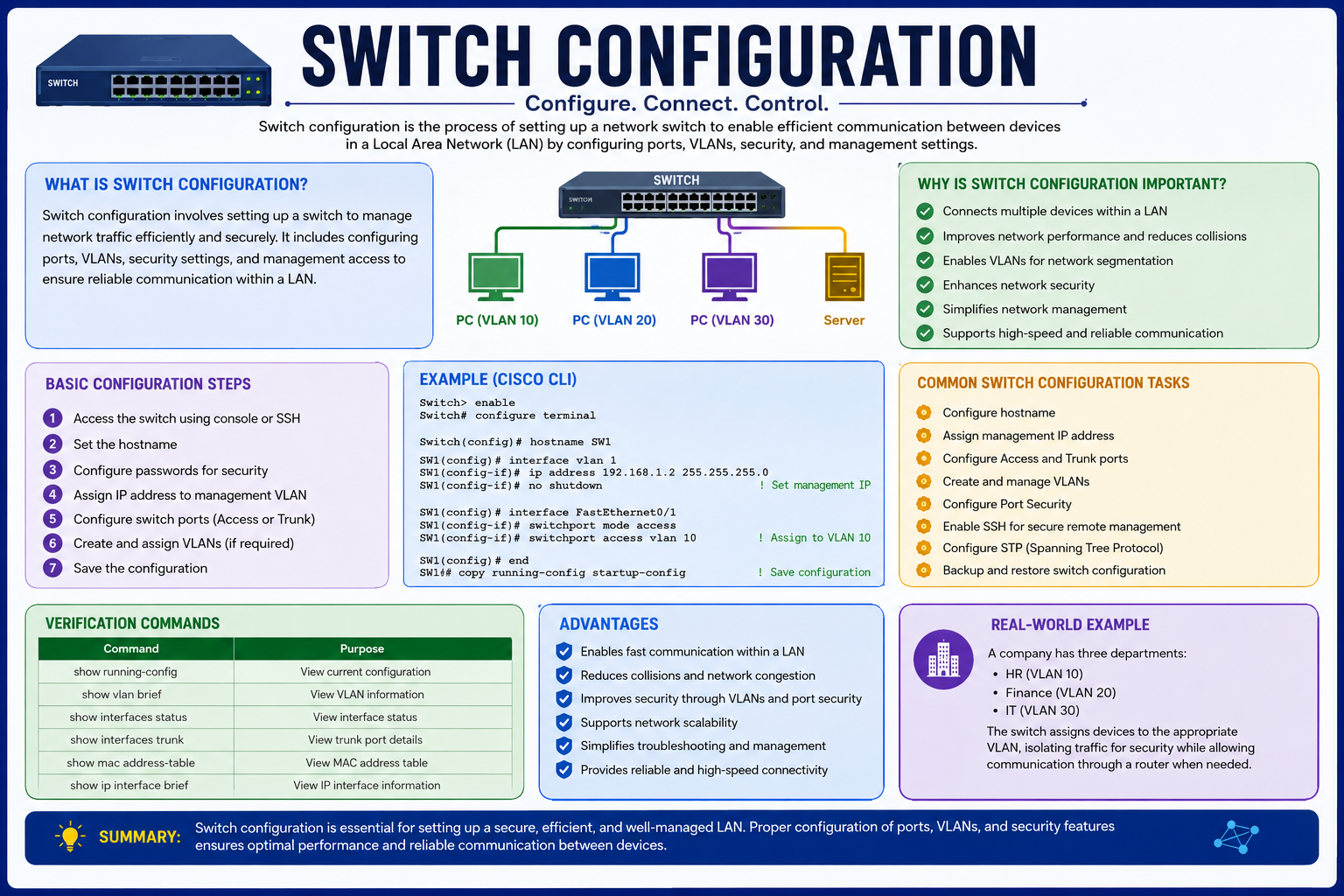
What is Switch Configuration?
Switch Configuration is the process of setting up a network switch to enable efficient communication between devices in a Local Area Network (LAN). It includes configuring switch ports, VLANs, security settings, management access, and other network features to ensure reliable and secure data transmission.
O
srikanth_20
14 days ago
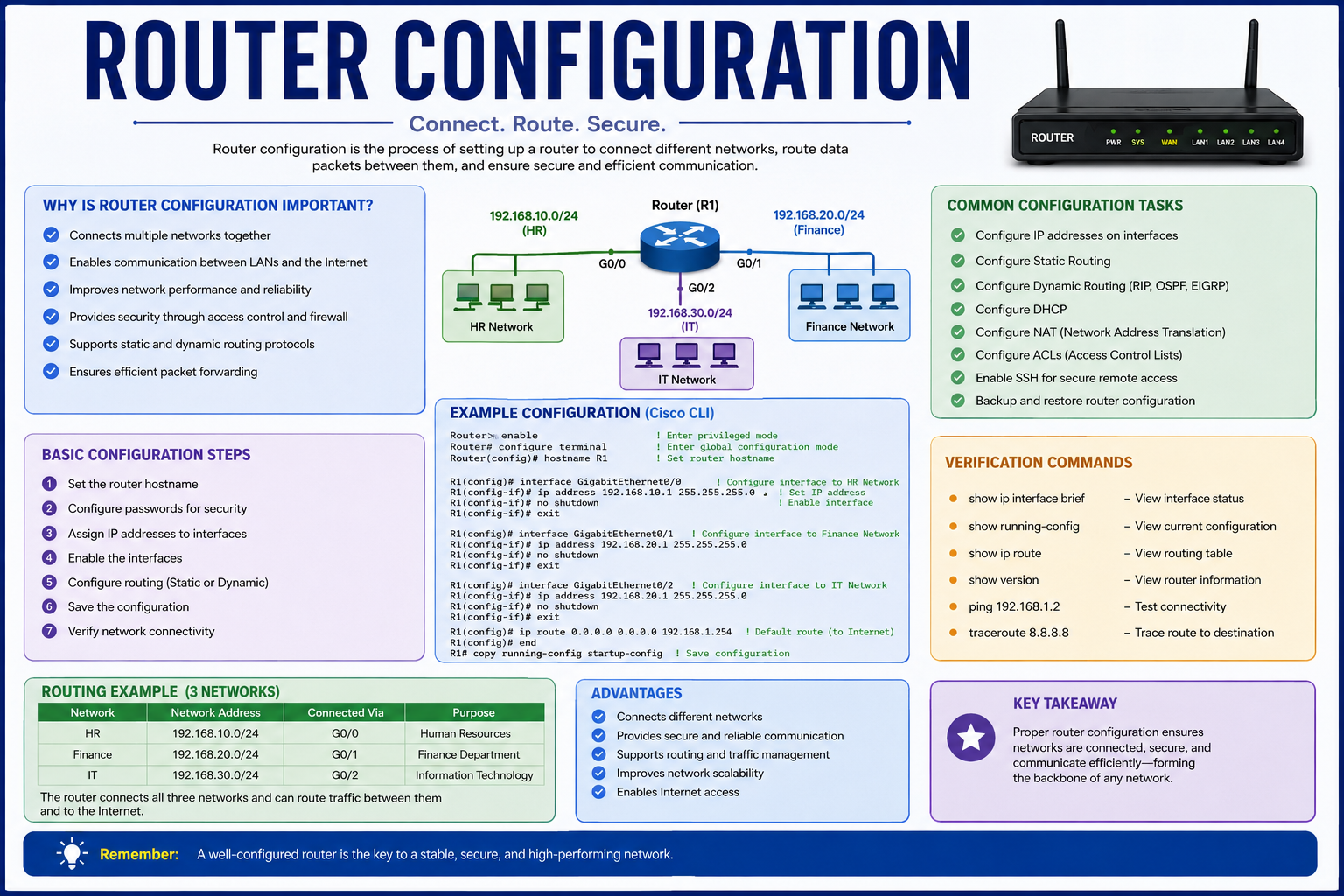
What is Router Configuration?
Router Configuration is the process of setting up a router to enable communication between different networks. It involves assigning IP addresses, configuring routing protocols, securing the device, and ensuring data packets are forwarded correctly between networks.
J
VertexPulse
14 days ago
AutoCAD Designer (Civil) - Hyderabad
We’re Hiring | AutoCAD Designer (Civil)
📍 Location: Sri Nagar Colony, Hyderabad
🕒 Experience: 0–2 Years
💰 Salary: ₹1.20 – ₹1.92 LPA
📌 Employment Type: Full-Time | Permanent
We are looking for a passionate AutoCAD Designer (Civil) to join our engineering team.
Key Skills:
✅ AutoCAD 2D & 3D
✅ Revit Architecture
✅ SketchUp
✅ BIM (Building Information Modeling)
✅ 3D Modeling & Rendering
✅ CAD Drafting
Eligibility:
🎓 B.Tech/B.E. in Civil Engineering
🎓 Freshers with strong AutoCAD & Revit skills are encouraged to apply.
If you’re looking to build your career in CAD design and engineering, we’d love to hear from you!
📧 Apply by sending your updated resume to: info@staffrex.in
📱 WhatsApp: +91 8897472357
Know someone who would be a great fit? Please like, share, or tag them in the comments.
#Hiring #AutoCAD #CivilEngineer #CADDesigner #Revit #SketchUp #BIM #3DModeling #EngineeringJobs #HyderabadJobs #FreshersJobs #CivilJobs #Recruitment #Staffrex #StaffrexInfoSolutions
O
srikanth_20
15 days ago
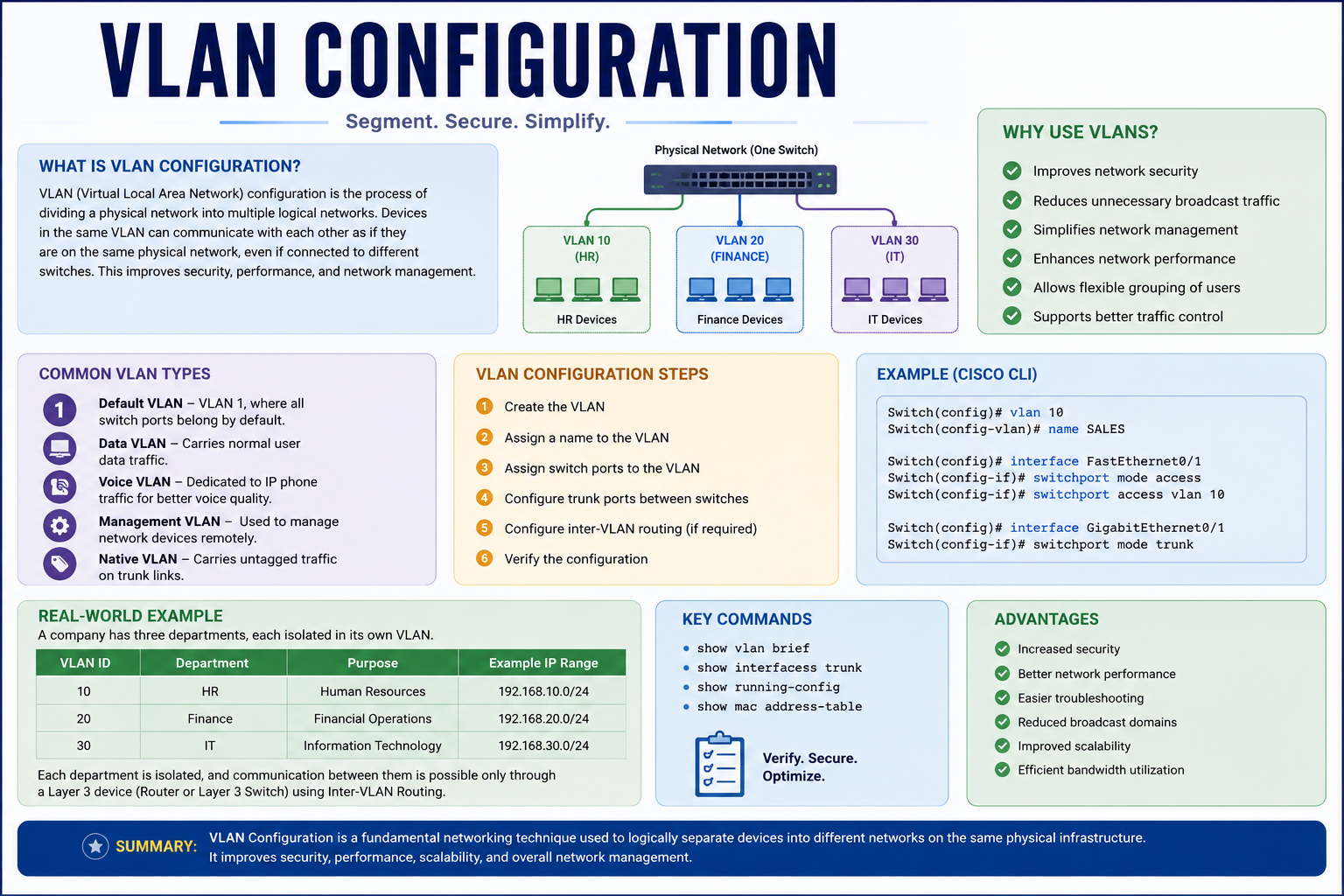
What is VLAN Configuration?
VLAN (Virtual Local Area Network) Configuration is the process of dividing a physical network into multiple logical networks. It allows devices to communicate as if they are on the same network, even when connected to different switches, while improving security, performance, and network management.
LogicBloom
15 days ago
🚀 The Best Open-Source Local LLMs for Coding & Agentic Workflows
Following up on the recent GLM and GRM releases, a lot of you are asking what other open-source models are worth running locally right now. The landscape has moved insanely fast this year, and you no longer need massive enterprise server racks to run highly capable AI.
If you are orchestrating agents (like utilizing LangGraph) or just want a smart offline assistant to help debug Django API serializers and React state management issues, here are the top alternatives you can spin up today:
1. The Local Heavyweight: Qwen3 (Specifically 3.6 27B)
Alibaba’s Qwen3 series has quietly become the default recommendation for local development.
- Why it rocks: It strikes the perfect balance between size, speed, and actual coding ability. It is exceptionally strong at reasoning, repo chat, and handling agentic workflows.
- The Specs: It operates under an Apache 2.0 license, meaning no commercial restrictions, and handles over 100 languages flawlessly.
-
Download: You can easily grab this via Ollama by running
ollama run qwen3:30b.
2. The UI/Visual Coder: Gemma 4 (31B IT QAT)
Google’s newest Gemma release is a game-changer because it isn’t just a text model; it is fully multimodal.
- Why it rocks: If you are building out frontends, you can feed it screenshots of your UI layouts or diagrams, and it will help you debug the code directly.
- The Specs: This version uses Quantization-Aware Training (QAT), making it incredibly practical to run on standard hardware while maintaining high benchmark scores on LiveCodeBench.
3. The Surprise Drop: gpt-oss-20b
Yes, OpenAI actually released an open-weight model under an Apache 2.0 license.
- Why it rocks: It provides that classic OpenAI-style reasoning but entirely under your control, ensuring strict local data residency. It comes out-of-the-box with built-in agentic capabilities like function calling and structured JSON outputs.
- The Specs: It supports a 128K context window and is specifically optimized to operate within a standard 16GB memory environment.
4. The Efficiency King: DeepSeek V4 Flash
If you want massive scale without melting your GPU, DeepSeek is currently dominating the Mixture-of-Experts (MoE) architecture space.
- Why it rocks: V4 Flash has 284 billion total parameters but only activates 13 billion per token during generation. This gives you lightning-fast inference with a massive 1-million token context window—perfect for analyzing massive, multi-file codebases.
O
srikanth_20
17 days ago
Wide Area Network (WAN)
A Wide Area Network (WAN) is a computer network that connects devices, offices, or local area networks (LANs) over large geographic distances, such as cities, countries, or even continents. Unlike a Local Area Network (LAN), which covers a small area like a home or office, a WAN enables communication between networks that are far apart
LogicBloom
17 days ago
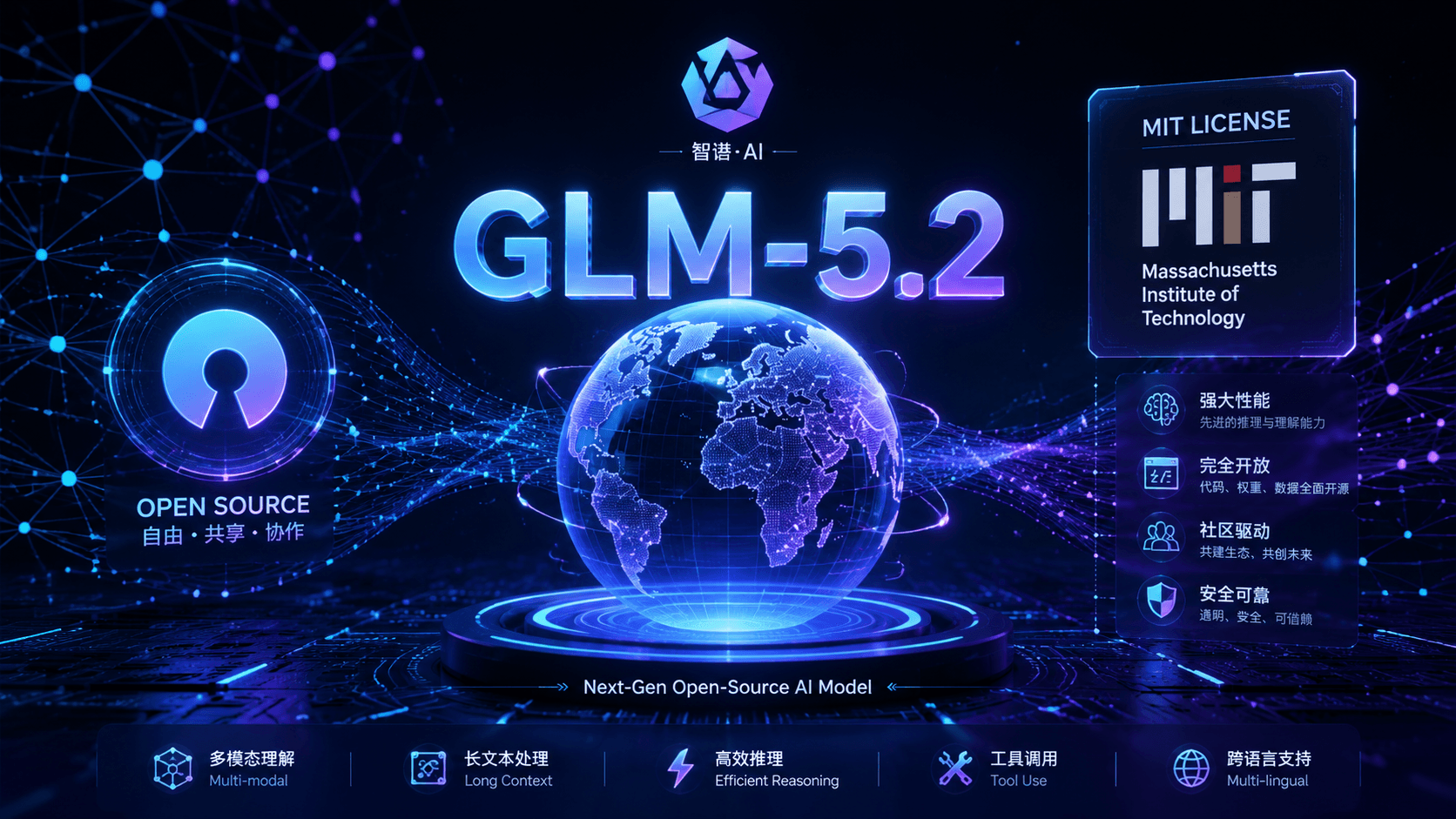
Why GLM-5.2 is Redefining Open-Source AI (A Technical Deep Dive)
Zhipu AI (now operating as Z.ai) recently dropped GLM-5.2, and it is sending shockwaves through the AI development community. Released as an open-weight model under a highly permissive MIT license, GLM-5.2 isn’t just another conversational chatbot — it is an engineering-grade model built specifically for “long-horizon” agentic tasks.
Here is a technical breakdown of why GLM-5.2 is outperforming top-tier proprietary models like GPT-5.5 and Claude Opus on critical software and reasoning benchmarks.
1. Massive 1-Million-Token Context Window
While many models struggle with “lost in the middle” degradation at high token counts, GLM-5.2 ships with a rock-solid 1-million-token context window.
- The Capability: It can ingest an entire enterprise software repository (code, documentation, and logs), full legal corpora, or massive datasets in a single prompt.
- Output Bandwidth: It can generate up to 131,072 output tokens per response, allowing it to generate or refactor enormous codebases in a single pass.
2. Next-Gen MoE Architecture & “IndexShare”
Under the hood, GLM-5.2 utilizes a highly optimized Mixture-of-Experts (MoE) architecture boasting roughly 750 billion total parameters.
- Inference Efficiency: During execution, it only activates about 40 billion parameters per token. This means you get the intelligence of a massive model at the computational cost of a much smaller one.
- IndexShare Attention: Z.ai introduced a novel sparse-attention technique called “IndexShare,” which reuses the same indexer across every four sparse attention layers. This architectural breakthrough reduces per-token FLOPs (floating point operations) by 2.9x at the 1M context length, making ultra-long context inference economically viable.
3. Dialing In “Thinking Effort”
Taking a page from cutting-edge reasoning systems, GLM-5.2 introduces explicit effort level control.
- Dynamic Compute: You are no longer stuck with a static compute-per-token ratio. You can toggle the model’s reasoning effort (e.g., “High” or “Max”) for complex, multi-step engineering problems.
- The Result: By allocating more compute at inference time, GLM-5.2 dramatically improves its performance on advanced coding and mathematical benchmarks, successfully balancing latency and capability on the fly.
4. Built for Long-Horizon Agentic Engineering
Unlike standard chat models that plateau after their initial response, GLM-5.2 is designed to run autonomously for hours.
- Benchmark Dominance: On tests like FrontierSWE (measuring open-ended project completion over tens of hours), GLM-5.2 edges out GPT-5.5 and trades blows directly with Claude Opus 4.8.
- Sustained Focus: It excels at reading environments, utilizing tools, decompiling sub-tasks, and maintaining strategy over hundreds of iterative rounds without losing focus or hallucinating.
5. True Open-Source Freedom
Many “open” models come with strict commercial restrictions or acceptable-use limits. GLM-5.2 breaks this trend by shipping under the MIT license.
- The Enterprise Advantage: Teams can self-host the model on-premises, fine-tune it on proprietary data (like medical records or corporate codebases), and build commercial products on top of it with zero vendor lock-in or licensing fees.
S
Brave_PandaRobot8361
20 days ago
🏏 Is This the End of an Era?
Some players score runs.
Some players create memories.
And then there’s Rohit Sharma.
As speculation grows that the upcoming ODI at Lord’s could be Rohit’s final appearance in India’s blue jersey, cricket fans around the world are reflecting on a career that redefined ODI batting. India’s team management has publicly backed Rohit despite the recent retirement talk, but questions about his future continue to dominate headlines.
From a record 264 in an ODI…
To three ODI double centuries…
To leading India to unforgettable victories…
The “Hitman” has given fans moments they’ll never forget.
If this truly is the final chapter, one thing is certain:
Legends don’t leave the game.
They leave behind a legacy.
💙 What’s your favorite Rohit Sharma memory?
Share it in the comments. 👇
#RohitSharma #Hitman #TeamIndia #Cricket #ODI #CricketFans #IndianCricket #Legend

LogicBloom
20 days ago
🚀 Run Powerful AI Locally: Why China's New GRM-2.5 (and GLM-5.2) Are Changing the Open-Source Game
There has been a massive wave of open-source AI releases recently, and if you are building local agentic workflows, you need to check these out.
We need to talk about two major drops, specifically focusing on what you can actually run right now on your own machines.
1. The Local Powerhouse: GRM-2.5
If you want something incredibly fast that you can spin up locally via Ollama or LM Studio, GRM-2.5 by OrionLLM is the model to grab.
- The Parameters: It is a highly optimized 4-billion (4B) parameter reasoning model.
- Why it rocks: Despite its compact size, it is explicitly trained for structured reasoning, code generation, and agent-style workflows.
- Performance: It runs efficiently on standard consumer hardware. If you are spinning up test environments on Pop!_OS or setting up local worker agents that don’t need a massive 70B model, this is perfect.
- Download: You can grab the weights directly from Hugging Face here: OrionLLM/GRM-2.5 on Hugging Face.
2. The Enterprise Giant: GLM-5.2
I also have to mention GLM-5.2 from Z.ai (formerly Zhipu AI). This was just released under a permissive MIT license and is currently ranking as one of the most capable open models in the world, beating models like Gemini 3.5 Flash on certain benchmarks.
- The Parameters: It is a massive Mixture-of-Experts (MoE) model with 744 billion total parameters (40 billion active during generation).
- The Catch: Unless you have a server farm in your basement, you aren’t running this locally. But it does offer a 1-million token context window, which is insane for analyzing massive codebases.
The Takeaway: The days of relying solely on expensive, closed APIs are ending. You can build your core multi-agent architecture using small, fast local models like GRM-2.5, and only call out to larger APIs when you absolutely need heavy-lifting reasoning.