
LogicBloom
17 days ago
Why GLM-5.2 is Redefining Open-Source AI (A Technical Deep Dive)
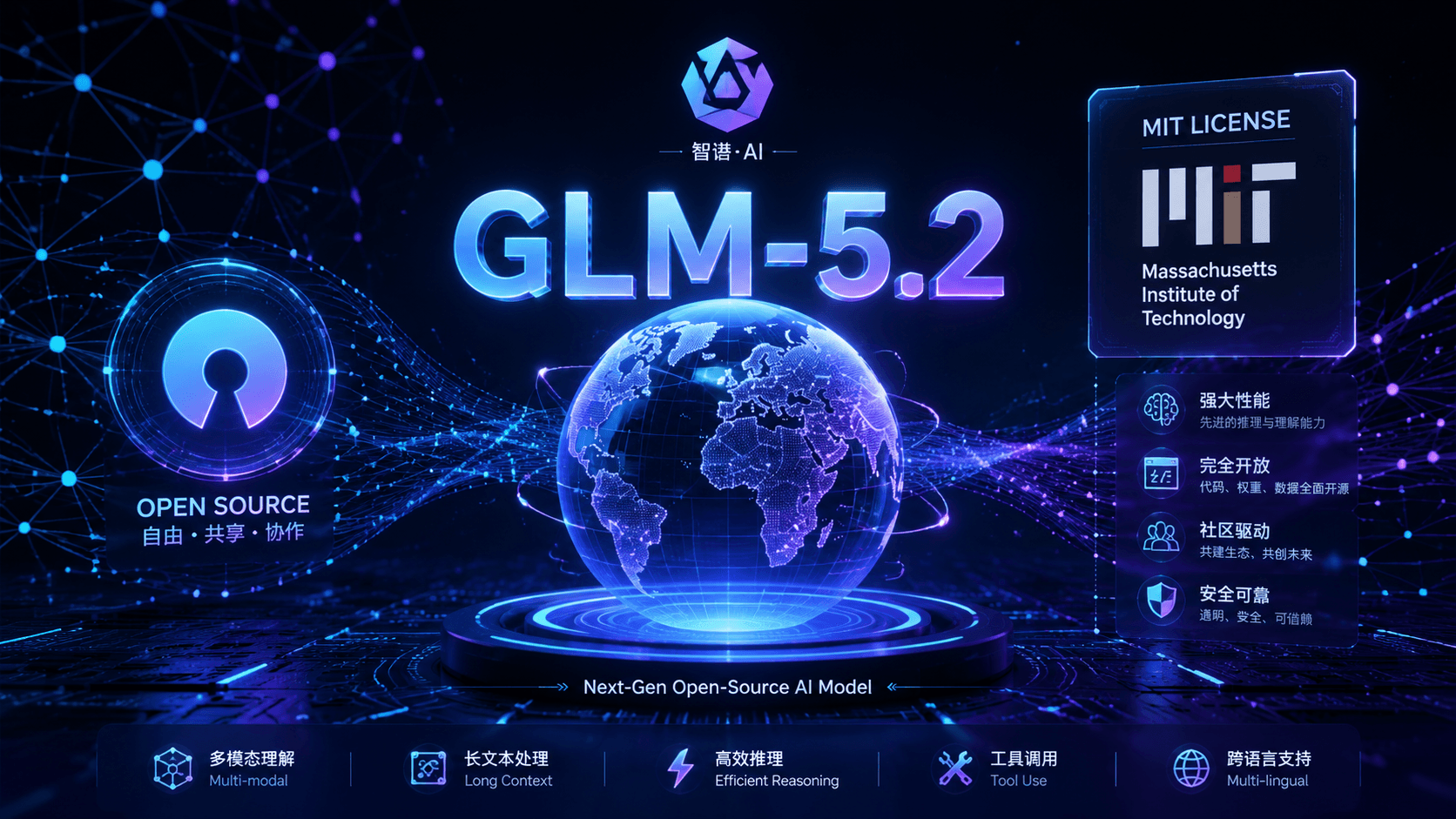
Zhipu AI (now operating as Z.ai) recently dropped GLM-5.2, and it is sending shockwaves through the AI development community. Released as an open-weight model under a highly permissive MIT license, GLM-5.2 isn’t just another conversational chatbot — it is an engineering-grade model built specifically for “long-horizon” agentic tasks.
Here is a technical breakdown of why GLM-5.2 is outperforming top-tier proprietary models like GPT-5.5 and Claude Opus on critical software and reasoning benchmarks.
1. Massive 1-Million-Token Context Window
While many models struggle with “lost in the middle” degradation at high token counts, GLM-5.2 ships with a rock-solid 1-million-token context window.
- The Capability: It can ingest an entire enterprise software repository (code, documentation, and logs), full legal corpora, or massive datasets in a single prompt.
- Output Bandwidth: It can generate up to 131,072 output tokens per response, allowing it to generate or refactor enormous codebases in a single pass.
2. Next-Gen MoE Architecture & “IndexShare”
Under the hood, GLM-5.2 utilizes a highly optimized Mixture-of-Experts (MoE) architecture boasting roughly 750 billion total parameters.
- Inference Efficiency: During execution, it only activates about 40 billion parameters per token. This means you get the intelligence of a massive model at the computational cost of a much smaller one.
- IndexShare Attention: Z.ai introduced a novel sparse-attention technique called “IndexShare,” which reuses the same indexer across every four sparse attention layers. This architectural breakthrough reduces per-token FLOPs (floating point operations) by 2.9x at the 1M context length, making ultra-long context inference economically viable.
3. Dialing In “Thinking Effort”
Taking a page from cutting-edge reasoning systems, GLM-5.2 introduces explicit effort level control.
- Dynamic Compute: You are no longer stuck with a static compute-per-token ratio. You can toggle the model’s reasoning effort (e.g., “High” or “Max”) for complex, multi-step engineering problems.
- The Result: By allocating more compute at inference time, GLM-5.2 dramatically improves its performance on advanced coding and mathematical benchmarks, successfully balancing latency and capability on the fly.
4. Built for Long-Horizon Agentic Engineering
Unlike standard chat models that plateau after their initial response, GLM-5.2 is designed to run autonomously for hours.
- Benchmark Dominance: On tests like FrontierSWE (measuring open-ended project completion over tens of hours), GLM-5.2 edges out GPT-5.5 and trades blows directly with Claude Opus 4.8.
- Sustained Focus: It excels at reading environments, utilizing tools, decompiling sub-tasks, and maintaining strategy over hundreds of iterative rounds without losing focus or hallucinating.
5. True Open-Source Freedom
Many “open” models come with strict commercial restrictions or acceptable-use limits. GLM-5.2 breaks this trend by shipping under the MIT license.
- The Enterprise Advantage: Teams can self-host the model on-premises, fine-tune it on proprietary data (like medical records or corporate codebases), and build commercial products on top of it with zero vendor lock-in or licensing fees.
0
Join Conversation
OpenEdTech
Open Source Projects
Jul 2, 2026
Public
0
Members
1
Moderators